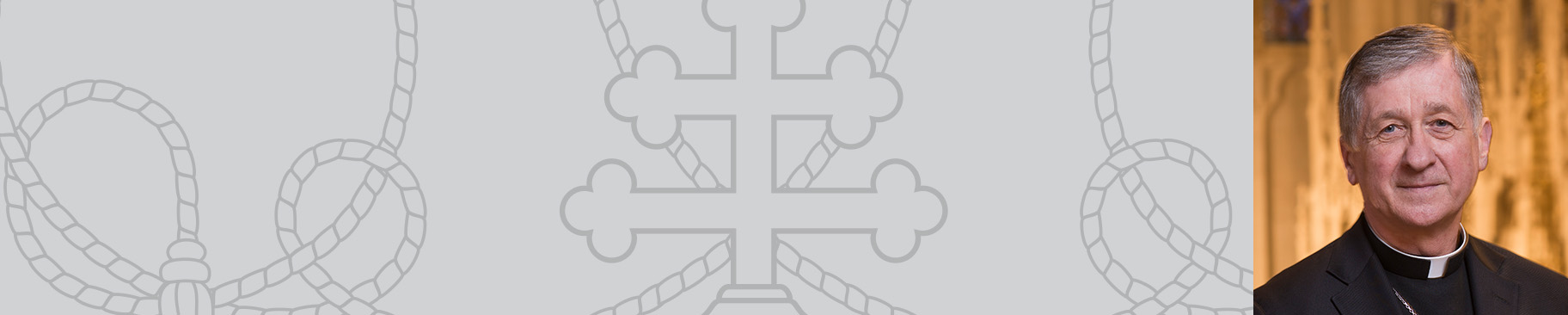
The cardinal delivered the following homily during the chrism Mass at Holy Name Cathedral on March 31.
What we do today, in blessing these holy oils, we do for and with the entire church, empowering all the baptized, as the pilgrim people of God, to move forward with new enthusiasm. But the chrism Mass has special meaning for our priests. For today as we bless these oils, our priests will renew the commitments they made when the Spirit of the risen Lord was invoked on them through the laying on of hands. They will do so by connecting to that moment in time when Jesus inaugurated his ministry and stood up in the synagogue to identify himself as fulfilling the ancient prophecy: “The Spirit of the Lord is upon me to proclaim glad tidings to the poor, liberty to captives and sight to the blind.”
On this day, we who pastor the people of God make that identity our own by reminding each other and those we serve that we minister in his holy name, not our own. While we take up his mission anew with all its burdens, we are refreshed in knowing that we are with him.
As such he invites us to swap a stressful, self-driven life for a life of trusting in his enduring presence and in God’s providence. It is that trust that emboldens us to pursue a mission that attends to the needs of the world in our time. It is a mission of liberation to the captives, to those who are the victims of war, trapped in cellars or behind borders. It is a mission to those blinded by nationalism or the “us vs. them” rhetoric that fuels discrimination and polarization. It is a mission to the oppressed, migrants and refugees who seek nothing more than the dignity of a safe home, only to find doors barred and hearts hardened.
In this moment our world, currently scarred by the “piecemeal” third world war that Pope Francis often spoke of, needs us to take up this mission. As priests, we are called to be “sacraments of peace,” that is, signs and effective instruments of peace, in a time of conflict, we are to be those who are sent into the world to speak of the “Prince of Peace” when the world cries for vengeance. We are called to be witnesses of a kingdom where borders matter less than the inescapable fact that we are all brothers and sisters to each other. We are to be vulnerable to the world’s wounds as we care for people who suffer from the cold heart of discrimination and injustice, whose dignity is questioned because of their race, culture, religion, language or legal status.
And as the Holy Father reminded us on Palm Sunday, we are to announce to the world “Jesus, King of Peace, who rejects war, whom no one can use to justify war.” And so let us join the Successor of Peter in saying that the King of Peace “does not listen to the prayers of those who wage war, but rejects them, saying (in the words of the prophet Isaiah), ‘Even though you make many prayers, I will not listen: your hands are full of blood’” (Is 1:15).
How do we in this moment speak to our people as we carry out this mission? What language do we use that is not tainted by partisan politics or the agenda of the world? The oils blessed today for our ministry help us in this regard for they offer a language and logic that is familiar to our people through their experiences of and participation in the sacramental life of the church.
With the oil of the sick, we announce by the soothing touch of our hands that Christians should never be afraid to draw close to the wounds of the world. And they are many.
We priests know from our gathering at bedsides and during hospital visits the sacred space of shared vulnerability and solidarity. It is there that we are reminded that a primary role of our ministry and the ministry of the church is to accompany, to be a field hospital, to be close to those who suffer, to allow our hearts to be moved as people tell us of their agony. And know this: it not just ailing individuals we care for, we also extend healing care to wounded communities.
It is in this sacred space that we experience the healing power of respecting the dignity of those who suffer by drawing close to them. The world needs this witness. While media and government may treat the wounds of conflict or illness as a distant spectacle, the act of anointing with our touch is visceral and real. By drawing close to others by our touch, we encourage our people to reject seeing those who suffer as a series of headlines, but rather as brothers and sisters who require an individual, tender touch.
With the oil of the catechumenate, often referred to as athlete’s oil, we strengthen those who have answered that call first heard on the shores of Galilee, “Come, follow me.” As we celebrate the power of God’s grace at work in them, we acknowledge that we are all a work in progress.
The journey of faith is not a sprint, but a long-form process of “strengthening” that requires immense patience and continuous purification. And so, we are not judgmental of others or overly demanding of progress, for just as oil cannot be forced into the skin, so God’s grace seeps in gradually. The great enemy of that long journey is discouragement. The oil of catechumens helps us and our people to hold fast.
The insights we gain in acknowledging that we each are a work in progress, should prompt us to examine our beliefs about how the world might better handle global conflicts. There is a strong temptation to seek conflict resolution by “surgical” strikes, regime change or other immediate solutions, which expect hearts to change as fast as a document is signed, or a bomb is dropped. Impatience that solutions do not come quickly often turns one to dehumanize the “other,” the enemy, with the aim of making the conflict easier to process mentally or of justifying the sidelining of diplomacy.
Our experience of the “slow soak” of grace as we anoint the catechumens, and witness how hearts are changed gradually through healing and purification, should prompt the Christian family to advocate for a different path for handling complex global problems. Pressing for a “quick fix” without the slow work of healing more often than not leads to a fragile peace that cracks under the first sign of pressure. The world needs this Christian witness of the slow soak of grace, and needs us to proclaim it.
Finally, the sacred chrism, the most “royal” of the holy oils, is used to seal a permanent character on the soul in baptism, confirmation and holy orders. The logic of chrism is a radical alternative to the logic of the world, for chrismation seeks internal transformation rather than the manipulation of the external world to exert dominance.
It reveals that the most important change is not who “rules” a territory, but who “rules” the human heart. It witnesses to the truth that real and lasting peace is achieved not through external force, for “dominance” is only as strong as the next weapon. Rather, peace comes by first transforming people, for peace is an internal quality of the soul. That royal transformation enables and invites our people to claim their true responsibility to be peacemakers in a wounded world.
Chrism also celebrates the permanence of our dignity, which stands against the disposability of life in a throw-away culture that denies the human dignity of the unborn, the terminally ill, the convict and in modern warfare, when individuals are treated as tactical units rather than anointed children of God. While the logic of worldly dominance seeks to control resources, the logic of chrism is generous, as it compels the anointed to claim responsibility and to give their lives in mission. It replaces the mission of the warrior who controls with the mission of the anointed, whose aim is to reconcile an enemy.
Brothers, the language and logic of these holy oils offer much to us as we renew our commitment to the mission Christ has given us. We have something decisively and absolutely important to bring into the world when we bring these oils forward. They offer us a language and logic that will help us speak to the daunting challenges our people face as they connect to their experience of participating in the sacramental life of the church.
So let us not hesitate to stand before those we serve, as Jesus did in his hometown synagogue, and with the confidence given to those anointed with the Spirit, proclaim glad tidings to the poor, liberty to captives, recovery of sight to the blind, freedom to the oppressed and a year of favor, trusting that God will move the hearts of our people so that once again this ancient prophecy and these promises will be fulfilled in their hearing.