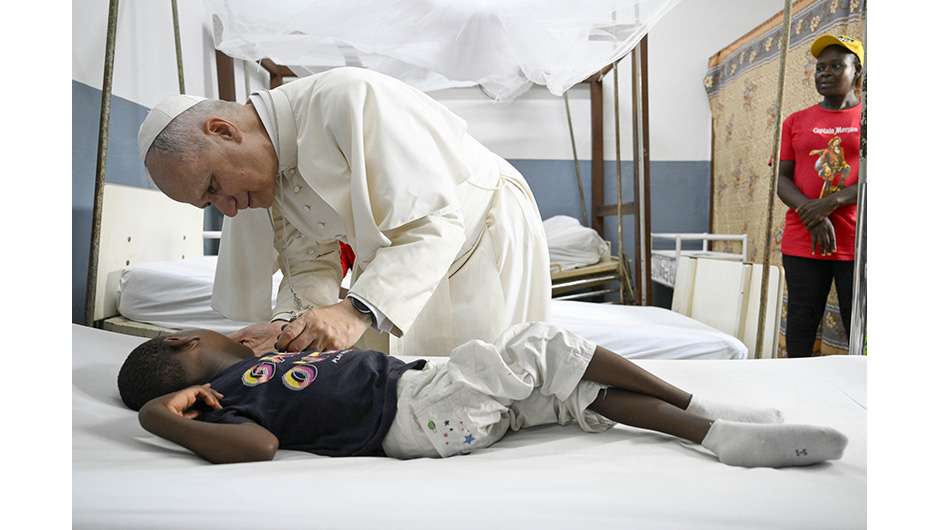
In the first year of his pontificate, Pope Leo XIV has introduced himself to the world as a leader in the Augustinian tradition, one who believes in the value of listening before making up his mind; an able manager with a deep understanding of the global church, and a pastor who wants to bring people to peace in God.
Those were among the conclusions of “Habemus Papam: Three Journalists Weigh in on Pope Leo’s First Year” hosted April 15 by the Hank Center for the Catholic Intellectual Heritage of Loyola University Chicago.
The discussion was planned long before the pope was in the news recently as President Donald Trump began verbally attacking him for advocating for peace and diplomacy, especially regarding the U.S. and Israeli conflict with Iran in the Persian Gulf region, according to Michael Murphy, director of the Hank Center.
“A few months ago, this seemed like perhaps a rather more straightforward topic of conversation,” said moderator Dominic Preziosi, editor of Commonweal magazine, which was among the event’s sponsors. “A U.S. born pope from the Chicago area, no less. An Augustinian, a pope who spent many years as a priest and bishop ministering to his community in Peru, a pope who seemed likely to represent continuity with the papacy of Francis, but who, inevitably, would chart a course of his own, hinting to that by his choice of name. A pope who has struck many as moderate and reasonable in his rhetoric, a capable manager, attentive to the pastoral, doctrinal, ecclesiastical, institutional responsibilities of being the leader of the world’s 1.4 billion Catholics.”
Pope Leo, Preziosi said, has focused on the obligation to care for the poor and vulnerable and on the need for the church to be in dialogue with the modern world, especially with the “seemingly inexorable advance” of artificial intelligence and its implications for human dignity and with war and peace, all very much in keeping with what was expected.
Then came the Trump administration’s campaign of mass deportation, the U.S. raid in Venezuela and the war with Iran, and President Trump attacking the pope by name in Truth Social posts and Vice President (and, Preziosi said to laughter, “noted theologian”) JD Vance attempting to school the pope on Catholic doctrine.
Colleen Dulle, Vatican correspondent for America magazine, noted that people often mention an opinion attributed to Cardinal Francis George, that the church would not elect an American pope until the U.S. was in state of “political decline.”
It’s true that the image of the United States on the world stage has changed, Dulle said, and it’s also true that Pope Leo, who spent 20 years ministering in Peru, traveled the world as prior general of the Augustinians and led the Vatican’s Dicastery for Bishops, has a broader perspective than most.
“Leo is looking far past him [President Trump]. … He’s playing a longer game, and he’s advocating something much greater, a message peace rather than a message of conflict with one particular leader,” she said.
Dulle said she is waiting to see how Pope Leo’s vision of ecclesiology is translated, noting that as a priest and bishop in Peru, he appointed and relied upon many lay leaders. Now he is bringing the cardinals together to discuss issues in a display of collegiality. How, she wondered, will that play out with Pope Francis’ commitment to synodality?
Pope Leo’s first year was, in many ways, a continuation of Pope Francis’ pontificate, as Francis died less than halfway through the Jubilee Year of Hope he had proclaimed, said Gretchen R. Crowe, editor-in-chief of OSV News. Leo continued with the schedule established for the year, and the first major document he released was one started by Francis.
If 2025 was a year of “revving his engines,” he picked up speed starting in January, calling for a meeting of cardinals that month and again in June, she said. People looking for a key to understand Pope Leo should look to St. Augustine, founder of the order Leo belongs to and which he led for 12 years.
“St. Augustine was a bishop, a theologian, a preacher, a writer and a doctor of the church. But perhaps, most of all, he was a child of God, searching for peace, and in a world desperate for peace, I would argue that Pope Leo, who has put such an emphasis on being a peacemaker, is driven by his own desire to help all people find the peace of Christ as Augustine did,” Crowe said.
Michael Sean Winters, columnist for the National Catholic Reporter, said the church benefited from the Ignatian insights of Pope Francis, a Jesuit, and will do the same with what Pope Leo teaches from St. Augustine.
“I think here in the U.S., what I’m really hoping is he will help us get a better sense of sin,” Winters said. “Peace, yes. I’m all for peace, but I think Americans have some really screwed up notions of sin. You saw that this week when that noted theologian JD Vance said the pope should stick to morality. And, you know, evangelicals do think morality is about me and Jesus, and my personal relationship, and he’s my personal savior. They don’t have a sense of social moral framework, and we Catholics do.”
The American political right seems to confine the idea of sin to some kinds of sexual activity, he said, while the left has reduced sin to injustice. Both miss how sin disrupts the relationship between people and God, something Augustine intimately understood.
“You know that most famous of the quote about, ‘our hearts are restless until they rest in the thee?’” he said. “That’s where grace is found: It’s when we’re resting in him and in his plan, and that certainly includes fighting injustice, but it also includes more than that. And I think the other great insight that Augustine had is that contrition and repentance give privileged access to grace. We don’t call Augustine the doctor of sin; he is called the doctor of grace. He doesn’t dwell on sin except to make you attentive to grace.”