

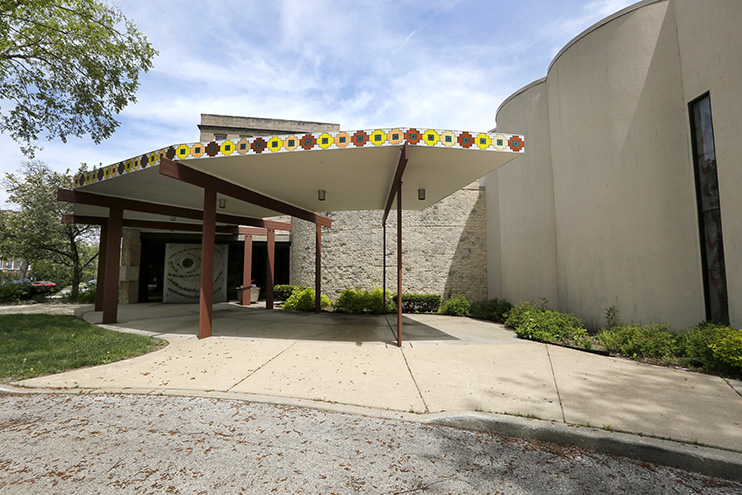
Nestled at the corner of 66th Street and South Steward Avenue in Englewood is a unique architectural gem of a church: St. Benedict the African Parish.
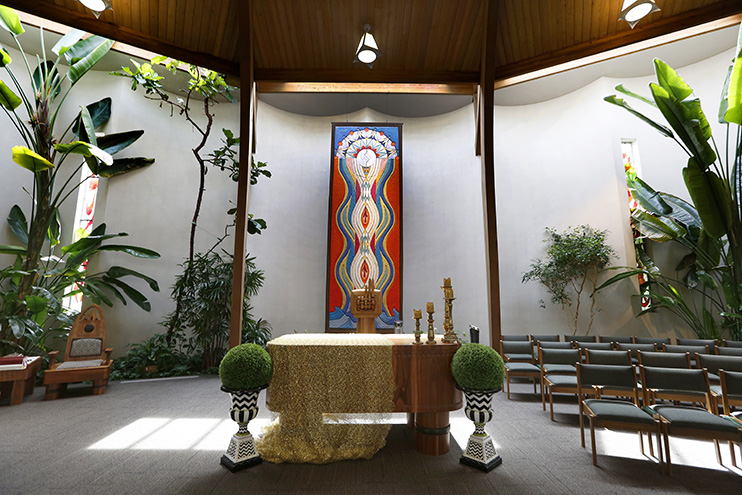
Designed with curves and circular features on the interior and exterior, the church sanctuary resembles the design of a traditional African hut. Natural light streams through skylights onto tropical plants that encircle the space, helping transport worshippers to another place.
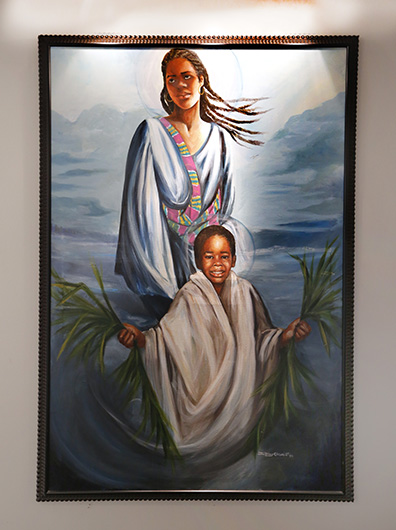
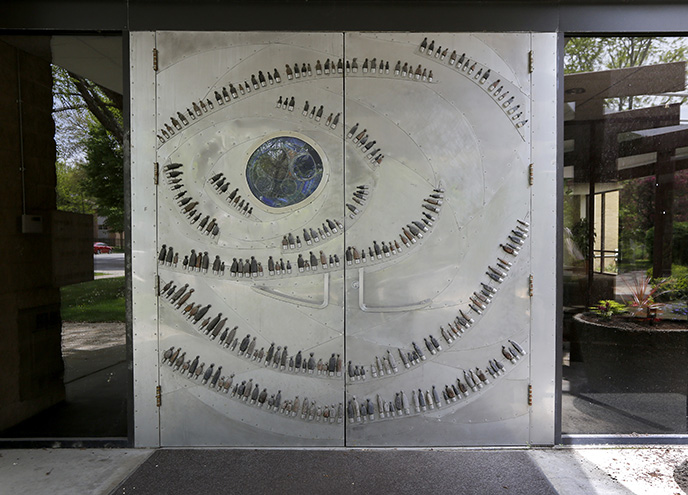
Religious art is an intentional feature of the church, enhancing the experience of the a predominantly African American congregation. The tradition dates back to the parish founding when, in the 1970s, Cardinal Joseph Bernardin asked Catholics in Englewood what they wanted the church in their neighborhood to look like and they said, “themselves.”
The historically German and Irish neighborhood had experienced white flight and the Catholic population plummeted as the area became predominantly African-American. Eight parishes were merged into one, with two worship sites; those two sites became separate parishes in 1995.
The pastor at St. Benedict the African-East had an eye for art, and that made all of the difference. The two parishes merged in 2016 into one St. Benedict the African Parish at the present site.
The architecture is so distinctive that the church has been included in the Chicago Architecture Foundation’s Open House Chicago.
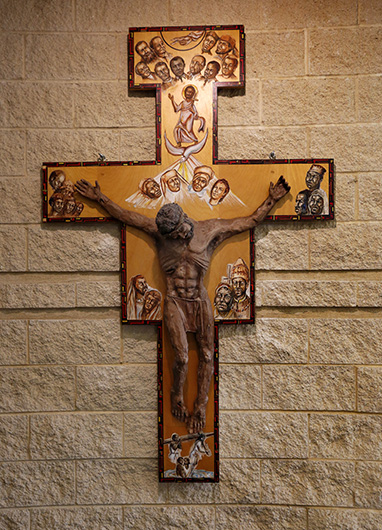
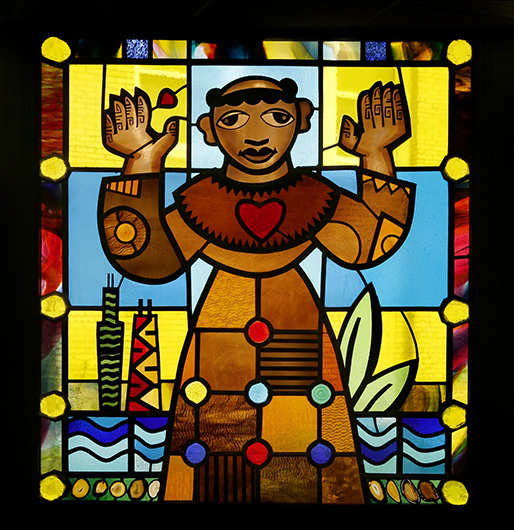
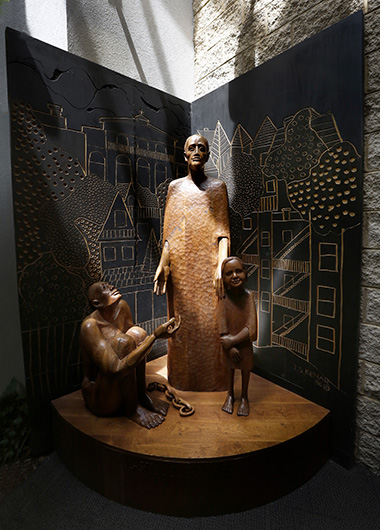
Art includes original Stations of the Cross; a hand-carved wooden statue of St. Martin de Porres in a setting also featuring the Chicago skyline; a large hand-woven tapestry that hangs behind the altar; and a crucifix in the tradition of the San Damiano cross that features historical figures key to the history of black Catholics in America, such as Father Augustus Tolton.
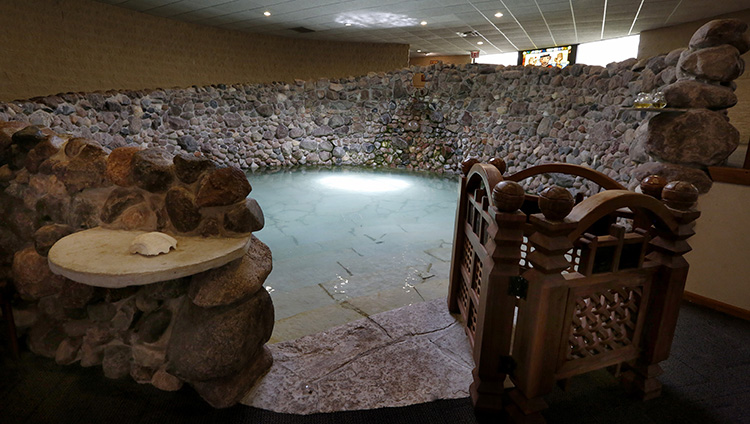
A focal point is a large baptismal font that holds 10,000 gallons of water.
“Without realizing it, what that original group of folks — the pastor, the parishioners, the architects and the artists — they created an extraordinary collection of originals. That’s what really gives it value,” said Father David Jones, pastor of St. Benedict the African.
Art in all its forms is such a part of the parish’s heritage that now it’s a line item in the budget.
When Jones became pastor, he realized the parish must preserve its art for future generations of Catholics. He created the Ann and Arthur Eiland Gallery in the gathering space. The gallery is named after one of the founding couples of St. Benedict the African who led the effort to create art for the parish.
In recent years, the parish added several outdoor Shona sculptures in soapstone from Zimbabwe.
“We have a collection of really terrific pieces of art, and they tell a story, but we have to keep the story going,” Jones said. “Now, this becomes the extension of that outdoors.”
Since the parish installed the outdoor pieces, Jones has noticed people, especially young men, stopping and looking at the art. They ask him about it when they see him, he said.
“It reaches populations we don’t normally reach,” Jones said. “It’s amazing to watch the children around these pieces because they interact with them.”
Adult parishioners do too, he added.
“It’s an energy in the parish that people are figuring out individually, but at the same time it’s developing community,” Jones said.
Jones has seen people have similar reactions to the art when they come for a funeral. The parish offers the church space to non-Catholic families in the community who need to bury loved ones because the space is the most beautiful in the area, he said.
“When people come, that can be like 200-plus people, they walk around, they talk about the art, they talk about their Catholic history,” Jones said. “There are so many people in the Black community who have a sense of Catholicism … Ninety-five percent of our people in our schools from the Black community were not Catholic by our definition, but they are by theirs. So I’m saying we just change the case and use the lowercase c.”
Artwork that reflects the reality of the people worshipping at the parish extends to bulletin covers. The parish uses artificial intelligence to generate artistic images for the covers and religious education materials. It does that with an eye for the young families in the parish, and the children especially.
“We can’t confuse them because all of the images don’t look like them. And because all of the images look foreign,” Jones said.
For Alexander Villaverde, his wife and three children, the art and architecture at St. Benedict the African gives a sense of being “less restrictive” than traditional churches.
“It broadens the sense of Catholicism and what it means to worship at first look, just offering something different,” he said. “In that we can learn to see the universality that’s in Catholicism.”
The round design of the worship space sends a message as well.
“With a circular kind of setting, it kind of gives the unity quality that is there. That may not be apparent but it’s subliminal,” Villaverde said. “When you are just all on one level in worship, it means something, it says something.”
The sanctuary is designed for everyone to come around the altar and the Eucharist, Villaverde noted, which makes everyone equal in the congregation.
The art resonates with other parishioners as well.
“I think it adds to the experience of church,” said parishioner Wayne Garris Jr., who has attended Mass with his wife and children for six years. “It has a very nature-like feel. I grew up in a Baptist church and a lot of the churches I grew up in looked the same.”
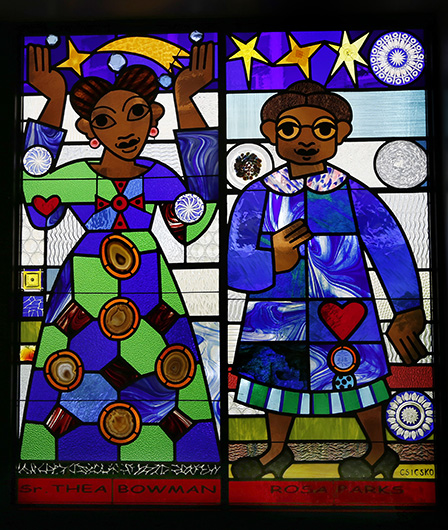
For his children to be able to see a reflection of themselves in the church aesthetics and the images of Black saints and holy people depicted in the stained-glass windows and artwork makes a difference.
“For them to see people that we admire and revere in our faith — that the image that they see is someone who looks like them, I think that’s great for them, and I think it’s great that they take it for granted,” Garris Jr. said.