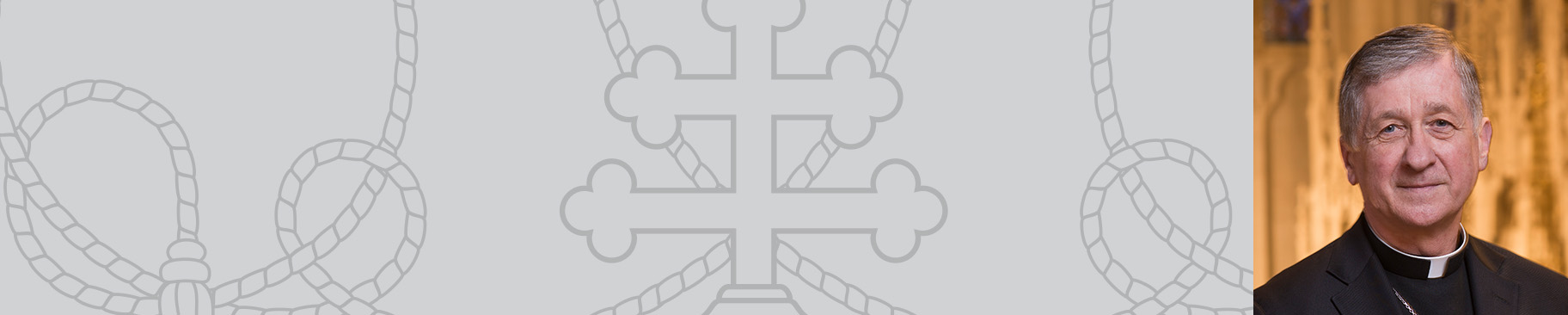
The cardinal delivered the following homily during the Mass for jubilarians celebrated April 17 at the University of St. Mary of the Lake/Mundelein Seminary.
We come together around the table of the Lord this noon hour to honor and celebrate our jubilarians marking 25 and 50 years of ministry. That is worth doing, for from the day of your ordination, you have spent these years standing at the intersection of the human and the divine.
You did so not by your own power but by the Spirit poured out on you. In all this time, like all those who entirely surrender themselves to the mission of Jesus Christ, you have become living witnesses of God’s faithfulness.
The Scripture texts just proclaimed are the readings of the day, and yet there is that happy coincidence that they speak so eloquently of all that we are celebrating today.
In Acts, as the disciples are being interrogated, the wise Pharisee Gamaliel offers a piece of advice that has echoed through the centuries:
“For if this endeavor or this activity is of human origin, it will destroy itself. But if it comes from God, you will not be able to destroy them.”
On the day of your ordination, you placed your hands in the hands of the bishop and made a promise. Over these decades, the world has shifted, cultures have changed, and the church has faced storms and crushing scandals. Yet here you stand.
A jubilee is the ultimate “Gamaliel Proof.” If this ministry were merely of human origin, based only on personal charm or human stamina, it would have withered long ago. But because it is from God, it not only has survived; it has thrived.
We celebrate today because we see the “God-origin” of this vocation. Your being here today is also a witness to the work and action of the Spirit in the church. Over the years, it too has been buffeted by trials, persecutions and yes, its own self-inflicted wounds and scandals, but again, here we are. I like the line of G. K. Chesterton, who once wrote, that over the centuries the church has gone to the dogs at least five times, but every time the dog died!
The Gospel also has much to say to us. It gives us the familiar scene of the multiplication of the loaves and fishes. It is not too much to say that the specific details of the scene featuring the boy with five barley loaves and two fish defines the heart of priesthood.
Andrew asks the question that every priest has felt at some point in his years of service: “What good are these for so many?” How can I as one man preach in a way that satisfies the spiritual hunger of thousands? How can my few words of absolution heal a lifetime of trauma? How can a piece of bread I offer become the Body of Christ?
The miracle of the priesthood is not that the priest is a superman with unlimited resources. The miracle is that the priest, like the young boy, places his “smallness” — his simple loaves and fishes — into the hands of Jesus.
Fifty and 25 years of priesthood is 50 and 25 years of watching Jesus take the “not enough” and making it the “more than enough.” If there ever was a Gospel scene that I would have liked to be part of it is this one, just to see the look on that boy’s face when he saw what Jesus did with his smallness. Yet, I suspect it is true for you as it is for me that many times over the years, we have had a similar experience of being overwhelmed with surprise of how the Lord has taken our smallness and fed so many.
Finally, look at how the Gospel concludes. After everyone was satisfied, Jesus said:
“Gather the fragments left over, so that nothing will be wasted.”
Your lives have been spent gathering fragments — gathering the fragments of broken families as you continue to walk with them and their children while others abandoned them, gathering up the fragments of lost souls who return to you time and again in your prayer but also in their pursuit of you for healing, gathering the fragments of hope in a dying person’s last breath, only to see family members once divided find forgiveness and unity in their shared grief. Over these years you have ensured that nothing is wasted in the kingdom of God.
Every Mass celebrated, every confession heard, every hospital visit and every silent prayer offered has been a way of gathering the people of God into the basket of divine mercy.
Yes, these are the readings of the day, and how appropriate they are, because each day you have experienced how all you do in feeding the people of God is God’s work. Like the disciples in Acts, you have emerged from many “trials” and the heart-wrenching scandals ready and willing to find joy amid sufferings and to feed the crowd, not with your own bread, but with the Bread of Life.
And like the boy in the Gospel, you can celebrate today that you have found the grace to be generous, ready to give what you have, and then be amazed at what Jesus can do with it. Indeed, the prayer uttered by the bishop on the day of your ordination has been answered time and again, for over these years God has brought to fulfillment the good begun work in you. Ad multos annos.